JHU MSECS
Program Overview & Advantages
MSECS is JHU's CS program and a well-known career-change-to-CS program. Each year it admits a considerable number of career-change students (many of whom have never taken any CS courses) — there have even been students admitted with an undergrad in Mining Engineering. Both career changers and CS majors should pay attention to this program.
The class size is small, which can be advantageous when applying for internships at certain companies (looking at you, Meta), though in the current climate this may not be as optimistic. Transferring to a PhD is a major advantage, as professors here prefer to recruit their own master's students for research projects.
Standardized Test Requirements
For the 2024 application cycle, the required scores were TOEFL 100 and GRE required. However, MSECS explicitly states on the application page that even if you submit GRE scores, they will not review them. The GRE requirement exists solely because of the parent school's policy (The Whiting School of Engineering requires GRE General Test scores for applications to all master's programs. However, the Department of Computer Science does not review these scores nor do they have any impact on the outcome of admissions decisions during the application review process.)
Admission Preferences & Representative Data Points
Based on previous years, a GPA of 3.7+ gives you a strong chance. However, note that this school will reject overqualified applicants — a friend got into Stanford but was rejected by MSECS.
- Southern University of Science and Technology, CS undergrad, GPA 3.8, with a short-term NetEase internship
- Southeast University, CS, GPA 3.83, IELTS 7.5
- University of Science and Technology Beijing, AI major, GPA 3.82, TOEFL 106
- IIT EE undergrad, one year full-time work experience
- Xi'an Jiaotong University, career changer, GPA 90.1
Job Outcomes & Data Points
- Southern University of Science and Technology, CS undergrad, GPA 3.8, short-term NetEase internship, landed AWS intern
- Three years work experience, landed Goldman Sachs Analyst
- IIT EE undergrad, one year full-time work experience, landed a small company
- Indian student, one year full-time work experience, landed new grad at a small company
- CS bachelor’s in India, multimodal LLM RA at Johns Hopkins Medicine during the master’s, full-time SWE at Amazon from 2025.
Student Experience
Most students choose a 3 + 4 + 3 course load across three semesters. If the last semester is part-time, you can opt for a 4 + 4 + 2 or 4 + 5 + 1 arrangement.
From five domains — Applications, Reasoning, Software, Systems, and Theory — you pick any 4 domains and take at least one course from each. You can choose many light-workload courses, such as EN.601.667 (01) Introduction to Human Language Technology or EN.601.783 (01) Vision as Bayesian Inference — famously easy courses — freeing up time for job hunting, resume submissions, and LeetCode grinding.
The school offers an audit option. If you enroll in an audited course through the system, it will appear on your transcript. Audited courses carry 0 credits, which creates a nice advantage: suppose in your first semester you want to take a demanding course like Operating Systems or Distributed Systems but are worried it will interfere with job hunting. You can choose to audit it, leading to two scenarios: 1. You can handle it and also land an internship — the ideal outcome where you attend class and take the course you want. 2. You cannot handle it, so you invest minimal time and focus on job hunting. You do not have to worry about failing because the course carries 0 credits and will not affect graduation. Either way, you cannot lose.
CS course enrollment priority is very high — no need to worry about not getting into the courses you want (the MSECS cohort is not very large to begin with). After course registration opens, students from other departments have to wait several days before they can enroll in CS courses. However, CS students face no restrictions when enrolling in other departments' courses — this is because within the engineering school, only CS has this enrollment protection. Popular courses such as CV, NLP, and ML give priority to CS students. The school offers both large and small classes — large classes have 40-50 students, while small classes may have fewer than 20.
Program Disadvantages
-
JHU is located in Baltimore, which has a relatively high safety risk. However, current students say it is not as bad as it sounds — there is a free shuttle service from 5:45 PM to 3:45 AM, and you can request a ride via the app. The library also has dedicated school buses during those hours to take you where you need to go.
-
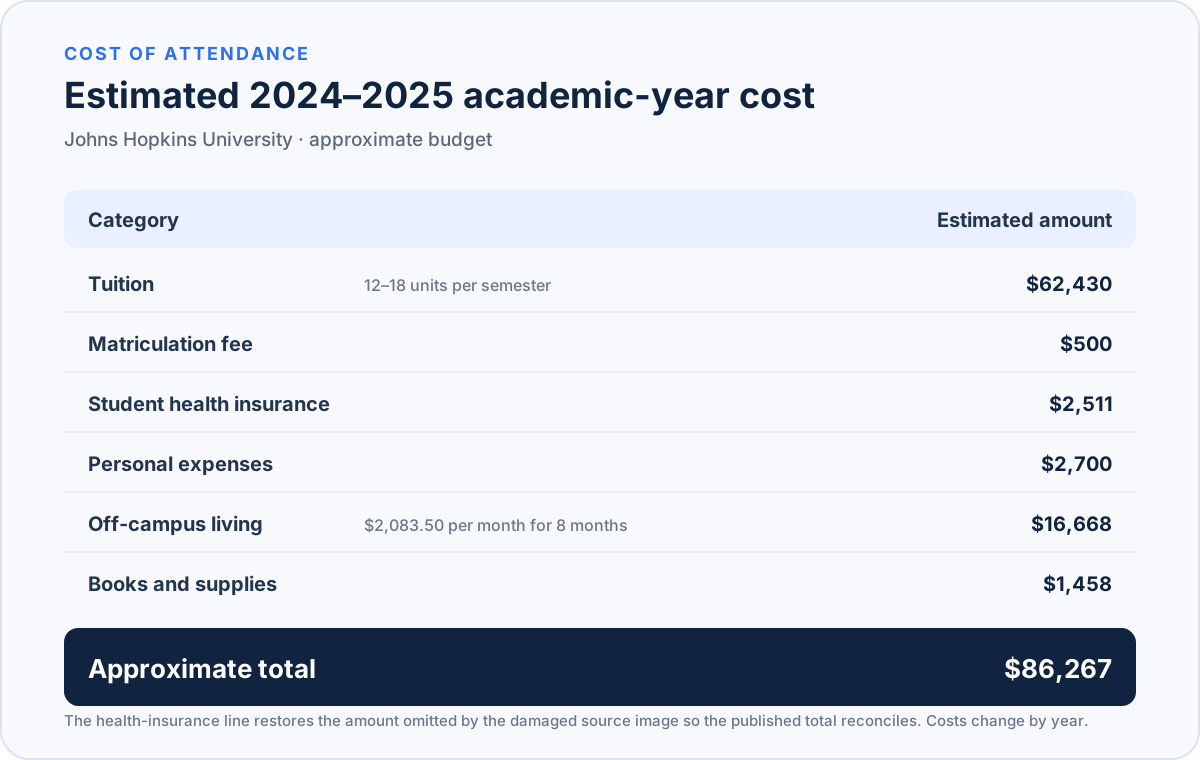
Expensive. Based on the offer letter for 23 fall MSECS admits, the total annual cost is $86,267. For 1.5 years, the total comes to $137,371.50.
One-Line Summary:
Personally, I think this program is underrated. Other than the high cost, everything is quite good (school ranking, student experience, workload, PhD transfer opportunities, job hunting convenience). Although it is a career-change program, CS majors can also apply. If your family budget is sufficient, I personally believe this program is no worse in quality than the A+ programs on Open CS App.